“…She opened up a book of poems
And handed it to me
Written by an Italian poet
From the thirteenth century
And every one of them words rang true
And glowed like burnin’ coal
Pourin’ off of every page
Like it was written in my soul…”
Bob Dylan, “Tangled up in Blue”1
Anyone at all enthused by our classical, Christian heritage–theology, philosophy, history, ethics, aesthetics, poetry, mythology–must read all three parts of Dante Alighieri’s The Divine Comedy2 (completed AD 1321): Inferno, Purgatorio, and Paradiso. And, your perusal of just Inferno in high school doesn’t count.
You might object to this. First, you will probably say The Divine Comedy is Roman Catholic theology, and of precisely the kind that started the Reformation. Isn’t Purgatory, after all, a nexus of just about everything wrong with Roman Catholic doctrine? Second, you will add the Comedy is very long, very complicated, and written in verse, so it’s hard to read.
In this review, I aim to meet both objections. First, I am going to tell you why you must read The Divine Comedy; second, I am going to give you a procedure for going about it.
At the outset, I will grant something to your first objection. The theology of the Comedy is not that of the Book of Concord, and you are going to disagree with many things. What is more, you are going to notice that things you took for common places are muted or missing. For example, you will always want more and better things to be said about the priestly office of Christ, about justification as a gift of grace, and about the righteousness that comes by faith alone.
Neither Luther nor the Book of Concord ever directly refer to Dante, so far as I can tell. Quite significantly, though, second-generation Lutherans, especially Mattias Flacius,3 found in Dante a co-belligerent contra the abuses of Rome, and even a harbinger of the Reformation in some ways. Flacius, it is reported, had a particularly good handle on Dante’s works, carried a copy of The Divine Comedy under his arm, like Alexander the Great carried Homer, and considered Dante among the faithful remnant of Christianity under papal domination. Flacius also credited Dante as the first to call out the “Donation of Constantine” as a forgery; Flacius was mistaken about this, but he is quite correct that Dante laments, throughout the Comedy, the damage done to Roman Christendom by the belief that the bishop of Rome is head of Church and State by divine right. Finally, Flacius included several excerpts from the Comedy in his Catalogue of Testimonies (the version from 1562), his monumental compilation of pre-Reformation witnesses to the Lutheran confession. For example, Flacius took from Paradiso this indictment of the Roman hierarchy and a prophecy of reform:
[…] the Gospel and the great Church Fathers are set aside and only the Decretals are studied—as their margins clearly show. On these the pope and cardinals are intent. Their thoughts are never bent on Nazareth, where Gabriel’s open wings were reverent.
And the hill of Vatican as well as other noble parts of Rome that were the cemetery for Peter’s soldiery will soon be freed from priests’ adultery. (Canto IX, 133-142; Mandelbaum)
Or, again in Paradiso, Dante criticizes the useless preaching of his day:
Each one strives for display, elaborates his own inventions; preachers speak at length of these–meanwhile the Gospels do not speak.
[…] Such fables, shouted through the year from pulpits–some here, some there–outnumber even all the Lapos and Bindos Florence has; so that the wretched sheep, in ignorance, return from pasture, having fed on wind–but to be blind from harm does not excuse them.
Christ did not say to his first company: ‘Go, and preach idle stories to the world’; but he gave them the teaching that is truth, the truth alone was sounded when they spoke; and thus, to battle to enkindle faith, the Gospels served them as both shield and lance.
But now men go to preach with jests and jeers, and just so long as they can raise a laugh, the cowl puffs up, and nothing more is asked. (Canto XXIX, 94-117; Mandelbaum).
Now, who does that sound like? Again, these and like passages are included by Flacius in the Catalogue of Testimonies. From the beginning, to the degree that they paid the Italian any attention, students of Luther have found much to appreciate in Dante. The first German translation of The Divine Comedy came before the Book of Concord, in 1573, from Lutheran pastor Conrad Lauterbach.
From this, it should be clear that the Comedy is much more than a poetic geography of spiritual realms. Instead, in a word, it is an epic. Modeling after the Aeneid, and with Virgil himself as guide partway, Dante takes the reader on a heaven-ordained quest through all the possibilities of human nature and destiny. His story begins in the middle of his own life, at what we now call a “mid-life crisis” (which means, incidentally, that you are never too old to start this journey with him). The route we follow is not through a manual of afterlife theology, but a manifold map of vice and virtue, of classical history and mythology, of the Bible and Christian history, all portrayed in relation to the Summum Bonum, communion with God.
Here, we find the mature (though not infallible) genius of Christendom, dissolving and reintegrating the pagan heritage with the Biblical and Christian, and the western Latin heritage into Dante’s own vernacular Italian. And this translation and elevation of the vulgar tongue to sing with the classics has always been the hallmark of the western spirit: in Virgil, in Dante, in the King James and Luther Bibles, in Shakespeare, and on and on.
Wrote Terence, famously, humani nihil a me alienum puto–“I consider nothing human alien to me.”4 Dante gives us a scope to comprehend, in light of God’s wrath, his call to repentance, and his upward call to glory, everything human. A place for everything and everything in its place: the whole human world of saints and sinners, the whole classical inheritance, the history of Christianity from Genesis to Dante’s present, his whole world and, by extension, our own. It is all in there.
As such a map of humanity, it is also a map of the human soul. In the depths of hell, on the painful mount of purgation, and in the heights of glory, the common feature is the presence of man. Man is present everywhere in the Comedy, so the whole Comedy is present, at least in potential, in every man. It is the macrocosm that reveals the possibilities of each microcosm; that is, the map of each of us. Man–every man, or any man–can be dragged to Inferno by his own passions; or can, in cooperation with God, undergo painful Purgatorio, unto holiness (FC SD II: 65-73); and can, by the grace of God, be brought to the perfection of love, Paradiso, and to the vision of the mystery that upholds the cosmos, the Holy Trinity.
I will go a step further. Despite its subject matter, Purgatorio is, to my mind, the most underrated piece of Christian fiction ever written.
I use the word “fiction” advisedly. Dante, like the western Christians of his time, believed in an intermediate, holy-making state or place of souls after death, before entering Paradise: Purgatory. However, even for Christians who hold to a doctrine of such a state or place, it would be better not to understand Purgatorio as intending to be a doctrinally precise explication of this place or assertion of its existence, nor a literal description of what to expect should you find yourself there.
It is, rather, a grand, metaphorical epic about the purification of the Christian soul, its liberation from the lower passions through repentance, the bearing of the cross, and the pursuit of the good, the true, and the beautiful. It has at least as much in common in form and intent with Protestant author John Bunyan’s Pilgrim’s Progress (published 1678-1684) as it does with The Catechism of the Catholic Church.
As we wrestle with the symbols of Purgatorio, we find that we understand from our own experience exactly what is going on, and we’ve met all the same people Dante has. Here, familiar things are heard and sung: Agnus Dei (Canto XVI), Te Deum laudamus (Canto IX), Gloria in excelsis deo (Canto XX), and many others, as the faithful await with certainty the consummation of all their faith and hope. The Reformation did not so much abolish this purging as bring it down to earth and enclose it within our temporal vocations: “The Old Adam in us should by daily contrition and repentance be drowned and die with all sins and evil desires, and a new man should daily emerge and arise to live before God in righteousness and purity forever” (SC IV). So, while we reject Purgatory, there’s a lot to learn in Purgatorio. It might just be the place in The Divine Comedy where Lutherans will feel most at home.
So much for why you should read. Here is how.
The procedure that I am going to recommend will both guide the first-time reader and enrich the experience of someone returning to the text. This procedure also assumes that you do not have anyone else to guide you through; if you do have someone, listen to him, not me. But in the likely event that you do not, allow me to be your Virgil.
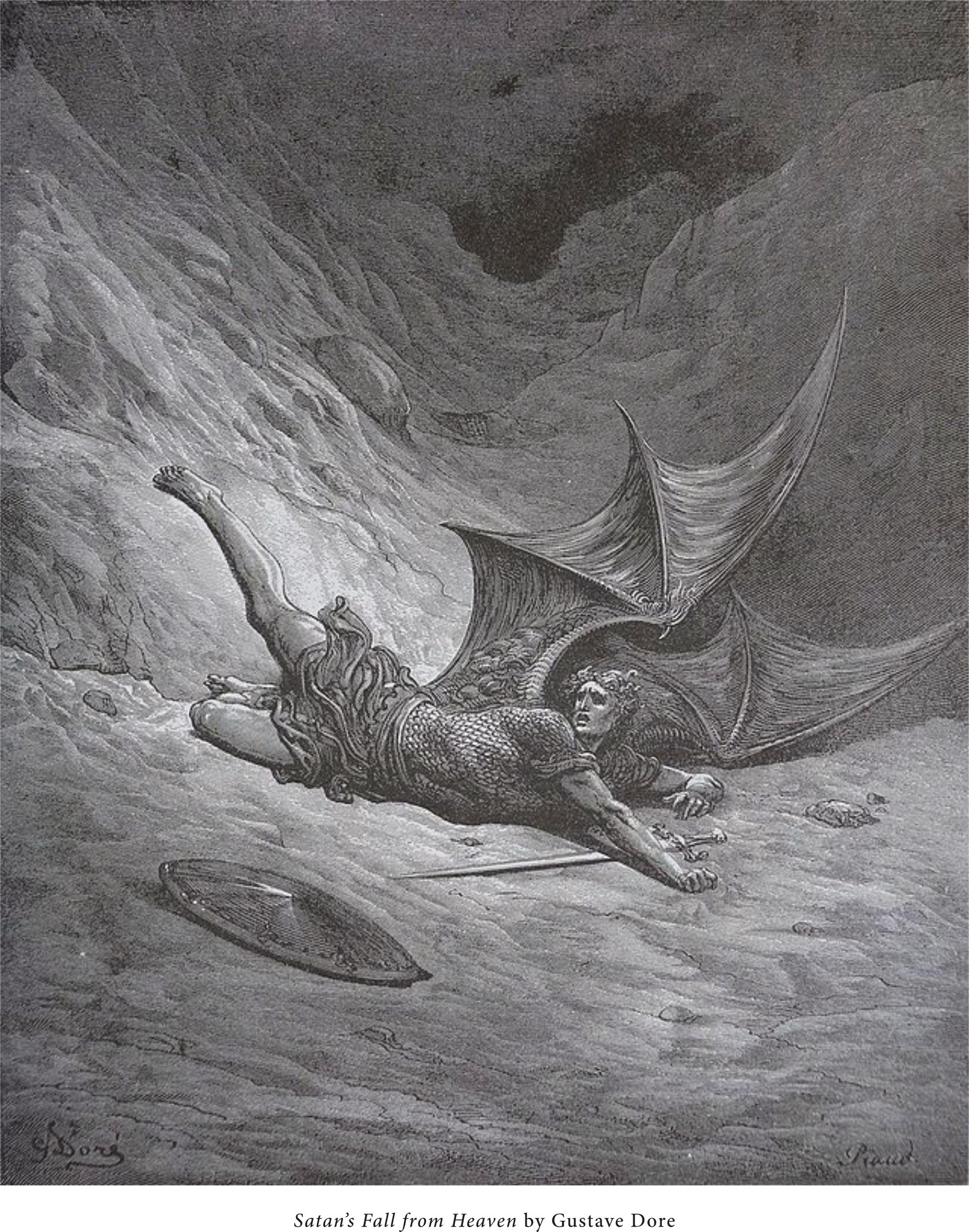
Get a hold of two translations of the Comedy. This procedure depends on your using exactly the two editions I’ve specified in the endnotes of this review. The first, which I’ll call Mandelbaum, is a modern verse translation into accurate and readable English. The second, which I’ll call Longfellow, is the classic English translation by one of America’s first and greatest poets, paired with Gustave Dore’s famous illustrations. The advantage of Mandelbaum is depth of study, especially the detailed notes on each section of the poem. The advantage of Longfellow is aesthetic, the beauty of the poetry and the wonderful illustrations. Compare the two versions of the opening lines (Inferno, Canto I, 1-3):
When I had journeyed half of our life’s way,
I found myself within a shadowed forest,
for I had lost the path that does not stray. (Mandelbaum)
Midway upon the journey of our life
I found myself within a forest dark,
For the straightforward pathway had been lost. (Longfellow)
Observe that Dante is calling this a spiritual autobiography. The poem is deeply autobiographical in a literal sense, too, and there is an incredible amount of information about Dante’s life and politics woven in.
Before beginning to read the poem, read all the introductory material in Longfellow, and scan the timeline in Mandelbaum. Observe, also, that the three books of the poem are each divided into thirty-three Cantos, except for the Inferno, which has thirty-four, bringing the number to one hundred.
Before you read each Canto, read the summary in Mandelbaum, and also quickly look over his notes for that Canto. Then, read the Canto in Mandelbaum, reread his notes, and, finally, read the Canto in Longfellow, and enjoy the illustrations. Repeat for each Canto until you arrive at the beatific vision of God in heaven. This will take a long time. Be patient.
The Divine Comedy has long been called “the Summa Theologica in verse,” referring to the theological work of Thomas Aquinas. But high-minded students of theology and the classics should take that description as a challenge and an inspiration rather than an excuse not to read it. If Dante can express the teaching of St. Thomas’s tomes of philosophical theology in beautiful verse, which elevate his own vernacular, then he has proven that systematic theology can rewrite the rules of literature. So, Lutherans of classical ambition should ask why no one has written a spiritual epic expressing the theology of the Book of Concord. The bar has been set high by Dante—one might say “among the stars”—but he has shown that it is doable. Someone should get to work on this.
Endnotes
1 Dylan is incorrect about “the thirteenth century,” as The Divine Comedy was completed in 1321; he could be given a pass, however, since it was not published until 1472.
2 I recommend these two translations:
Dante Alighieri, The Divine Comedy, trans. Henry Wadsworth Longfellow, illus. Gustave Dore (San Diego: Canterbury Classics, 2013).
Dante Alighieri, The Divine Comedy, trans. Allen Mandelbaum (New York: Alfred A. Knopf–Everyman’s Library, 1995).
3 The good name of Matthias Illyricus Flacius (d. 1575) as a genuine Lutheran has been damaged, through his own fault, by Article I of the Formula of Concord. Beyond his blunder and necessary rebuke, though, Flacius should be admired as a faithful, learned, tenacious, and long-suffering disciple of Luther, who fought hard and won decisively for the true sense of the Unaltered Augsburg Confession. For a brief summation, see Concordia: A Reader’s Edition of the Book of Concord, (St. Louis: CPH, 2006), 689; for a detailed and sympathetic reading of his overstatements and their corrections, see F. Bente, Historical Introductions to the Lutheran Confessions (St. Louis: CPH, 2005), 335-354; for an exhaustive summary of his life and contribution to confessional Lutheranism, see Oliver K. Olson, Matthias Flacius and the Survival of Luther’s Reform (Minneapolis: Lutheran Press, 2011). All of the information in this review about Flacius and Dante is taken from Olson’s book, pages 32, 35, 228, 238, and 250.
4 Publius Terentius Afer, The Self-Tormentor, Act 1, scene 1.